致电我们 (925) 660-7544

加利福尼亚州的受托人费用:受托人应获得多少报酬?

Determining appropriate trustee fees in California presents a minefield of potential conflicts and legal questions. The line between fair compensation and excessive fees often blurs, leaving trustees and beneficiaries alike uncertain about their rights and obligations. Whether you’re entitled to 1% (or more) of trust assets annually or should receive hourly compensation depends on a number of factors established by both trust documents and California law.

At Barr & Douds Attorneys, our trust administration lawyers have guided countless trustees and beneficiaries through these challenging compensation questions, helping them establish reasonable trustee compensation while fulfilling their fiduciary duty.

What Exactly Are Trustee Fees?

Trustee fees represent compensation paid to a trustee for managing a trust estate. These fees compensate the trustee for the time, effort, and specialized knowledge required to oversee trust assets and fulfill the trustee’s responsibilities according to both the trust document and the California Probate Code.

Serving as a trustee isn’t merely an honorary position — it entails significant legal obligations and potential personal liability. The trustee bears a fiduciary duty to act solely in the beneficiaries’ best interests while managing what often represents a family’s life savings and legacy.

What Exactly Are Trustee Fees?

California Probate Code section 15681 establishes that trustees are entitled to “reasonable compensation under the circumstances” when the trust instrument fails to specify compensation within its terms. What constitutes “reasonable” remains deliberately flexible, which allows courts to evaluate each situation based on its unique characteristics.

Additional relevant code sections include:

  • Section 15684: Authorizes reimbursement for legitimate expense reimbursement for trust-related expenses.
  • Section 15686: Requires 60 days advance written notice to beneficiaries when increasing compensation above what’s specified in the trust document.

Professional vs. Non-Professional Trustee Fees: A Revealing Comparison

The trustee’s background and qualifications significantly impact what constitutes reasonable compensation. California courts recognize that different types of trustees bring varying levels of expertise and efficiency to trust administration, which directly affects appropriate fee structures.

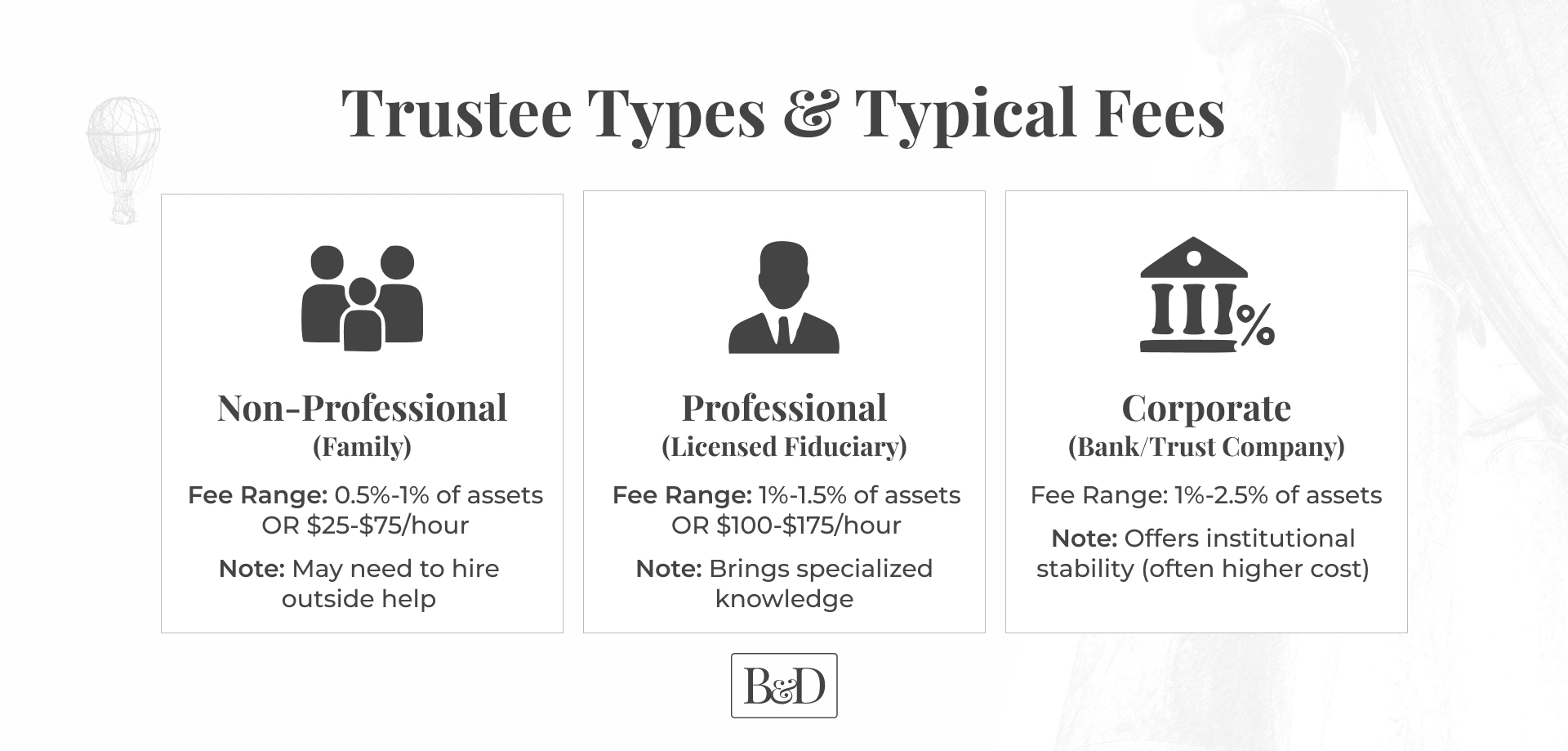
Let’s examine how compensation typically differs across trustee categories (The following is used as an example and not necessarily reflective of actual or expected trustee compensation):

Trustee Types & Typical Fees

Non-Professional Trustees (Typically Family Members)

  • Percentage basis: 0.5% to 1% of trust assets annually.
  • Hourly rate: $25-$75 per hour.
  • Key consideration: Often lack specialized knowledge and must hire professionals to assist with complex matters.

Professional Trustees (Licensed Fiduciaries)

  • Percentage basis: 1% to 1.5% of trust assets annually.
  • Hourly rate: $100-$175 per hour, or higher.
  • Key consideration: Bring specialized knowledge but command higher fees.

Corporate Trustees (Banks/Trust Companies)

  • Percentage basis: 1% to 2% of trust assets annually (sometimes higher).
  • Key consideration: Provide institutional stability but typically charge premium rates.

Professional vs. Non-Professional Trustee Fees: A Revealing Comparison

8 Crucial Factors Courts Consider When Evaluating Trustee Fees

When beneficiaries challenge trustee fees or when trustees seek court approval for their compensation, California courts don’t simply apply a one-size-fits-all formula. Rather, judges methodically evaluate multiple elements to determine what constitutes reasonable compensation in each unique situation.

These eight factors form the foundation of most judicial determinations regarding trustee fees in California:

  1. Trust estate size and complexity: Larger, more complex trusts justify higher compensation.
  2. Time investment: Hours devoted to trust administration duties.
  3. Administrative success: How effectively the trustee managed trust assets.
  4. Specialized expertise: Special skills the trustee brought to their role.
  5. Risk and responsibility assumed: Personal liability exposure and decision-making burden.
  6. Trustee loyalty: Whether the trustee acted with unwavering dedication to beneficiaries.
  7. Local standards: Customary fees in the particular county where trust administration occurs.
  8. Extraordinary services: Whether the trustee performed duties beyond routine administration.
信托管理

Trust Administration Raising Complicated Fee Questions?

Schedule a consultation with our attorneys to clarify your rights and obligations!

Extraordinary Services That May Justify Higher Compensation

Standard percentage-based trustee fees typically cover ordinary trust administration activities such as collecting assets, paying bills, filing routine tax returns, and making distributions. However, California law recognizes that some trust situations demand extraordinary efforts beyond these baseline duties.

The following scenarios frequently qualify as extraordinary services that may justify additional trustee compensation beyond standard rates:

  • Business management: Operating or selling a trust-owned business.
  • Complex property matters: Managing real estate, especially commercial properties or out-of-state holdings.
  • Litigation defense: Representing the trust in legal proceedings.
  • Tax complexities: Handling intricate tax situations beyond standard filings.
  • Challenging beneficiary dynamics: Managing high-conflict situations among beneficiaries.

Practical Financial Implications: Taxes and Trustee Fees

B&D are not tax professionals; please consult your tax professional regarding tax advice.

Trustee compensation isn’t just about determining a fair rate — it can carry significant tax consequences:

  • Trustee fees may constitute taxable income to the trustee.
  • The trust may deduct trustee fees as an administrative expense.
  • For successor trustees who are also beneficiaries, accepting fees means potentially paying taxes on money they would otherwise receive tax-free through inheritance.

Strategic timing of fee payments can minimize tax impacts. Taking smaller, regular payments may prevent pushing the trustee into higher tax brackets compared to one large lump sum.

Practical Financial Implications: Taxes and Trustee Fees

Essential Documentation Practices for Trustees

To justify fees and prevent disputes, meticulous record-keeping is essential:

  • Hire a tax professional.
  • Maintain detailed time logs documenting all trust administration activities.
  • Create a dedicated trust administration account with its own Taxpayer Identification Number.
  • Track all trust-related expenses separately, avoiding commingling trust expenses with personal expenses.
  • Document extraordinary services with particular thoroughness.
  • Retain all receipts and evidence of trust expenditures.

When Courts May Deny Trustee Compensation

Courts can reduce or completely deny trustee fees in cases of:

  • Breach of fiduciary duty
  • Self-dealing with trust assets
  • Negligent trust management
  • Failure to maintain adequate records
  • Commingling personal and trust funds

One Bay Area trustee purchased a fully-loaded pickup truck using trust funds, claiming it represented their fee. The court ordered full repayment plus penalties.

When Courts May Deny Trustee Compensation

Real-World Scenario: How Trustee Fees Impact Distributions

Case Example: A $1 million trust estate was managed by a professional trustee charging 1.5% annually for three years of administration.

  • Total trustee fees: $45,000.
  • Additional professional fees (accountant, attorney): $15,000.
  • Total administrative costs: $60,000.
  • Remaining trust assets for beneficiaries: $940,000.

Had a family member served as trustee at 0.5% annually, the total administrative costs might have been approximately $30,000, preserving an additional $30,000 for beneficiaries.

The determination of fair trustee fees demands careful consideration of numerous factors including estate value, administrative complexity, time commitment, and specific trustee’s duties outlined in the trust document.

At Barr & Douds Attorneys, our trust administration lawyers provide precision guidance on establishing reasonable trustee compensation, documenting administrative activities to justify fees, resolving disputes over trustee pay, creating proper trust accounting systems, and defending trustees against unjustified fee challenges. Our team stands ready to protect your interests with tailored solutions that align with both legal requirements and fiduciary responsibilities. Call us today at (925) 660-7544 for a free consultation about trustee fees in California, or schedule online!

FAQ: Common Questions About Trustee Fees in California

Can a trustee pay themselves without court approval?

Yes, if the trust document specifies compensation or if the amount constitutes reasonable compensation. However, trustees risk personal liability if fees are later deemed excessive.

How often can trustees collect fees?

Typically, trustees may collect reasonable fees quarterly or annually. The trust instrument may specify a schedule.

What expenses can trustees be reimbursed for beyond their fees?

Legitimate trust-related expenses including travel costs, professional services, postage, insurance premiums, and other costs directly related to trust administration.

Can beneficiaries challenge trustee fees?

Yes, under California Probate Code section 17200, beneficiaries may petition the court to review and potentially reduce trustee compensation.

Must trustee fees be approved by all beneficiaries?

No legal requirement exists for beneficiary approval, but transparent communication about fees can prevent disputes and litigation.
Loren Barr
by Loren Barr
Updated: May 7, 2026

本文为律师广告。本文仅供一般信息参考,不构成法律建议。本文所含信息不能替代就您的具体法律情况咨询合格律师。阅读或回复本文并不构成律师与客户之间的委托关系。以往的案件结果并不保证未来能获得类似结果。

相关报道

How to Transfer Firearms from a Deceased Person to Trust Beneficiaries in California?
With over 300 million guns in the hands of private citizens in America, it’s not surprising that California trustees often find themselves in...
Exclusion of Expert Report That Exceeds Scope of Evidence Code  §730 Appointment
This article discusses three ways to attack the report of an Evidence Code §730 expert when the expert’s report goes beyond the scope of the...
A Trustee’s Reasonable Reserve
In a trust administration, a “reserve” is money the trustee retains for a period of time after the trustee believes the trust...